
Carl Ford Carl Ford
0 Записани курсове • 0 Course CompletedБиография
최신업데이트버전L5M4시험대비덤프최신버전덤프문제공부
만약 아직도CIPS L5M4시험패스를 위하여 고군분투하고 있다면 바로 우리 Pass4Test를 선택함으로 여러분의 고민을 날려버릴 수 잇습니다, 우리 Pass4Test에서는 최고의 최신의 덤프자료를 제공 합으로 여러분을 도와CIPS L5M4인증자격증을 쉽게 취득할 수 있게 해드립니다. 만약CIPS L5M4인증시험으로 한층 업그레이드된 자신을 만나고 싶다면 우리Pass4Test선택을 후회하지 않을 것입니다, 우리Pass4Test과의 만남으로 여러분은 한번에 아주 간편하게CIPS L5M4시험을 패스하실 수 있으며,CIPS L5M4자격증으로 완벽한 스펙을 쌓으실 수 있습니다,
CIPS L5M4 시험요강:
| 주제 | 소개 |
|---|---|
| 주제 1 |
|
| 주제 2 |
|
| 주제 3 |
|
| 주제 4 |
|
L5M4최신 덤프데모 다운로드, L5M4덤프최신문제
Pass4Test에는 베터랑의전문가들로 이루어진 연구팀이 잇습니다, 그들은 it지식과 풍부한 경험으로 여러 가지 여러분이CIPS인증L5M4시험을 패스할 수 있을 자료 등을 만들었습니다, Pass4Test 에서는 일년무료 업뎃을 제공하며, Pass4Test 의 덤프들은 모두 높은 정확도를 자랑합니다. Pass4Test 선택함으로 여러분이CIPS인증L5M4시험에 대한 부담은 사라질 것입니다.
최신 CIPS Level 5 Advanced Diploma in Procurement and Supply L5M4 무료샘플문제 (Q37-Q42):
질문 # 37
What are three financial risks in exchange rate changes and how might an organization overcome these? (25 points)
정답:
설명:
See the answer in Explanation below:
Explanation:
Exchange rate changes pose financial risks to organizations engaged in international trade. Below are three risks and mitigation strategies, explained step-by-step:
* Transaction Risk
* Step 1: Define the RiskLoss from exchange rate fluctuations between invoicing and payment (e.
g., a stronger supplier currency increases costs).
* Step 2: MitigationUse forward contracts to lock in rates at the time of contract agreement.
* Step 3: OutcomeEnsures predictable costs, avoiding cash flow disruptions.
* Translation Risk
* Step 1: Define the RiskImpact on financial statements when converting foreign subsidiary earnings to the home currency (e.g., weaker foreign currency reduces reported profits).
* Step 2: MitigationHedge via currency swaps or maintain natural hedges (e.g., matching foreign assets and liabilities).
* Step 3: OutcomeStabilizes reported earnings, aiding financial planning.
* Economic Risk
* Step 1: Define the RiskLong-term currency shifts affecting competitiveness (e.g., a stronger home currency makes exports pricier).
* Step 2: MitigationDiversify operations or sourcing across countries to spread exposure.
* Step 3: OutcomeReduces reliance on any single currency's performance.
Exact Extract Explanation:
The CIPS L5M4 Study Guide identifies these risks and solutions:
* Transaction Risk:"Arises from timing differences in international payments, mitigated by forwards" (CIPS L5M4 Study Guide, Chapter 5, Section 5.1).
* Translation Risk:"Affects consolidated accounts and can be managed through hedging or balance sheet strategies" (CIPS L5M4 Study Guide, Chapter 5, Section 5.1).
* Economic Risk:"Long-term exposure requires strategic diversification" (CIPS L5M4 Study Guide, Chapter 5, Section 5.1).These align with managing FX volatility in procurement. References: CIPS L5M4 Study Guide, Chapter 5: Managing Foreign Exchange Risks.===========
질문 # 38
Describe what is meant by 'Supply Chain Integration' (8 marks). How would a buyer go about implementing this approach and what benefits could be gained from it? (17 marks).
정답:
설명:
See the answer in Explanation below:
Explanation:
Part 1: Describe what is meant by 'Supply Chain Integration' (8 marks)
Supply Chain Integration (SCI) refers to the seamless coordination and alignment of processes, information, and resources across all parties in a supply chain-suppliers, manufacturers, distributors, and buyers-to achieve a unified, efficient system. In the context of the CIPS L5M4 Advanced Contract and Financial Management study guide, SCI emphasizes collaboration to optimize performance and deliver value. Below is a step-by-step explanation:
* Definition:
* SCI involves linking supply chain partners to work as a cohesive unit, sharing goals, data, and strategies.
* It spans upstream (suppliers) and downstream (customers) activities.
* Purpose:
* Aims to eliminate silos, reduce inefficiencies, and enhance responsiveness to market demands.
* Example: A buyer and supplier share real-time inventory data to prevent stockouts.
Part 2: How would a buyer go about implementing this approach and what benefits could be gained from it? (17 marks) Implementation Steps:
* Establish Collaborative Relationships:
* Build trust and partnerships with suppliers through regular communication and joint planning.
* Example: Set up quarterly strategy meetings with key suppliers.
* Implement Information Sharing Systems:
* Use technology (e.g., ERP systems, cloud platforms) to share real-time data on demand, inventory, and forecasts.
* Example: Integrate a supplier's system with the buyer's to track orders live.
* Align Objectives and KPIs:
* Agree on shared goals and performance metrics (e.g., delivery speed, cost reduction) to ensure mutual accountability.
* Example: Both parties target a 95% on-time delivery rate.
* Streamline Processes:
* Redesign workflows (e.g., joint procurement or production planning) to eliminate redundancies.
* Example: Co-develop a just-in-time delivery schedule.
Benefits:
* Improved Efficiency:
* Streamlined operations reduce waste and lead times.
* Example: Cutting order processing time from 5 days to 2 days.
* Cost Savings:
* Better coordination lowers inventory holding costs and optimizes resource use.
* Example: Reducing excess stock by 20% through shared forecasting.
* Enhanced Responsiveness:
* Real-time data enables quick adaptation to demand changes.
* Example: Adjusting supply within 24 hours of a sales spike.
* Stronger Relationships:
* Collaboration fosters trust and long-term supplier commitment.
* Example: A supplier prioritizes the buyer during shortages.
Exact Extract Explanation:
Part 1: What is Supply Chain Integration?
The CIPS L5M4 Advanced Contract and Financial Management study guide does not dedicate a specific section to SCI but embeds it within discussions on supplier relationships and performance optimization. It describes SCI as "the alignment of supply chain activities to achieve a seamless flow of goods, services, and information." The guide positions it as a strategic approach to enhance contract outcomes by breaking down barriers between supply chain partners, aligning with its focus on value delivery and financial efficiency.
* Detailed Explanation:
* SCI integrates processes like procurement, production, and logistics across organizations. The guide notes that "effective supply chains require coordination beyond contractual obligations," emphasizing shared goals over transactional interactions.
* For example, a manufacturer (buyer) integrating with a raw material supplier ensures materials arrive just as production ramps up, avoiding delays or overstocking. This reflects L5M4's emphasis on operational and financial synergy.
Part 2: Implementation and Benefits
The study guide highlights SCI as a means to "maximize efficiency and value," linking it to contract management and financial performance. It provides implicit guidance on implementation and benefits through its focus on collaboration and performance metrics.
* Implementation Steps:
* Establish Collaborative Relationships:
* Chapter 2 stresses "partnership approaches" to improve supplier performance. This starts with trust-building activities like joint workshops, aligning with SCI's collaborative ethos.
* Implement Information Sharing Systems:
* The guide advocates "technology-enabled transparency" (e.g., shared IT platforms) to enhance visibility, a cornerstone of SCI. This reduces guesswork and aligns supply with demand.
* Align Objectives and KPIs:
* L5M4 emphasizes "mutually agreed performance measures" (e.g., KPIs like delivery accuracy). SCI requires this alignment to ensure all parties work toward common outcomes.
* Streamline Processes:
* The guide suggests "process optimization" through collaboration, such assynchronized planning, to eliminate inefficiencies-a practical step in SCI.
* Benefits:
* Improved Efficiency:
* The guide links integrated processes to "reduced cycle times," a direct outcome of SCI. For instance, shared data cuts delays, aligning with operational goals.
* Cost Savings:
* Chapter 4 highlights "minimizing waste" as a financial management priority. SCI reduces excess inventory and transport costs, delivering tangible savings.
* Enhanced Responsiveness:
* The guide notes that "agile supply chains adapt to market shifts," a benefit of SCI's real- time coordination. This supports competitiveness, a strategic L5M4 focus.
* Stronger Relationships:
* Collaboration "builds resilience and trust," per the guide. SCI fosters partnerships, ensuring suppliers prioritize the buyer's needs, enhancing contract stability.
* Practical Application:
* For XYZ Ltd (from Question 7), SCI might involve integrating a raw material supplier into their production planning. Implementation includes an ERP link for inventory data, aligned KPIs (e.g.,
98% delivery reliability), and joint scheduling. Benefits could include a 15% cost reduction, 3- day faster lead times, and a supplier committed to priority service during peak demand.
* The guide advises balancing integration costs (e.g., IT investment) with long-term gains, a key financial consideration in L5M4.
질문 # 39
John is looking at the potential of three different projects and is considering the Return on Investment. What is meant by this, and what are the benefits and disadvantages of using this method? Which option should he choose? (25 marks)
정답:
설명:
See the answer in Explanation below:
Explanation:
Part 1: What is meant by Return on Investment (ROI)? (8 marks)
Return on Investment (ROI) is a financial metric used to evaluate the efficiency or profitability of an investment by measuring the return generated relative to its cost. In the context of the CIPS L5M4 Advanced Contract and Financial Management study guide, ROI is a key tool for assessingthe financial viability of projects or contracts, ensuring they deliver value for money. Below is a step-by-step explanation:
* Definition:
A math equation with numbers and a square AI-generated content may be incorrect.
* Net Profit = Total Returns - Investment Cost.
* Purpose:
* It helps decision-makers like John compare the financial benefits of projects against their costs.
* Example: A project costing £100k that generates £120k in returns has an ROI of 20%.
Part 2: Benefits and Disadvantages of Using ROI (10 marks)
Benefits:
* Simplicity and Clarity:
* ROI is easy to calculate and understand, providing a straightforward percentage to compare options.
* Example: John can quickly see which project yields the highest return.
* Focus on Financial Efficiency:
* It aligns with L5M4's emphasis on value for money by highlighting projects that maximize returns.
* Example: A higher ROI indicates better use of financial resources.
* Comparability:
* Allows comparison across different projects or investments, regardless of scale.
* Example: John can compare projects with different investment amounts.
Disadvantages:
* Ignores Time Value of Money:
* ROI does not account for when returns are received, which can skew long-term project evaluations.
* Example: A project with returns in Year 3 may be less valuable than one with returns in Year 1.
* Excludes Non-Financial Factors:
* It overlooks qualitative benefits like quality improvements or strategic alignment.
* Example: A project with a lower ROI might offer sustainability benefits.
* Potential for Misleading Results:
* ROI can be manipulated by adjusting cost or profit definitions, leading to inaccurate comparisons.
* Example: Excluding hidden costs (e.g., maintenance) inflates ROI.
Part 3: Which Option Should John Choose? (7 marks)
Using the data provided for the three projects, let's calculate the ROI for each to determine the best option for John. The table is as follows:
A screenshot of a phone AI-generated content may be incorrect.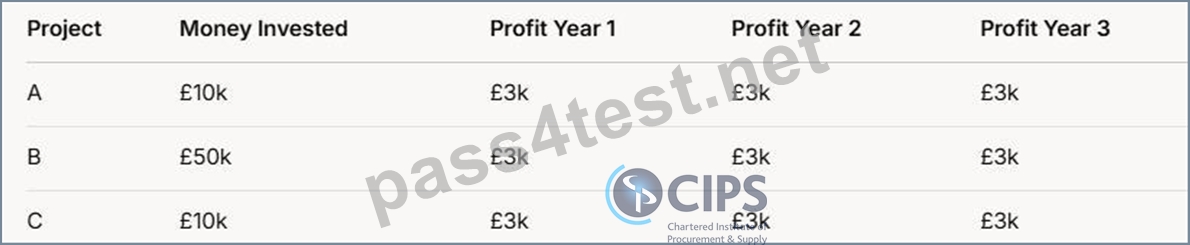
Step 1: Calculate Total Profit for Each Project:
* Project A: £3k (Year 1) + £3k (Year 2) + £3k (Year 3) = £9k
* Project B: £3k (Year 1) + £3k (Year 2) + £3k (Year 3) = £9k
* Project C: £3k (Year 1) + £3k (Year 2) + £3k (Year 3) = £9k
Step 2: Calculate Net Profit (Total Profit - Investment):
* Project A: £9k - £10k = -£1k (a loss)
* Project B: £9k - £50k = -£41k (a loss)
* Project C: £9k - £10k = -£1k (a loss)
Step 3: Calculate ROI for Each Project:
A group of math equations AI-generated content may be incorrect.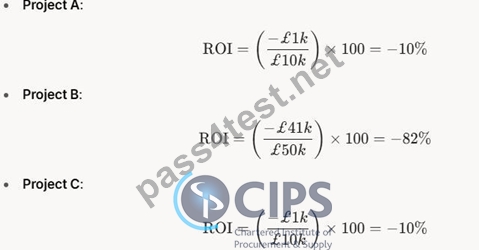
Step 4: Compare and Choose:
* Project A: -10% ROI
* Project B: -82% ROI
* Project C: -10% ROIAll projects show a negative ROI, meaning none generate a profit over the investment cost. However, Projects A and C have the least negative ROI at -10%, while Project B is significantly worse at -82%. Between A and C, the ROI is identical, but both require the same investment (£10k) and yield the same returns. Therefore, there is no financial difference between A and C based on ROI alone. However, since the question asks for a choice, John should choose eitherProject A or Project Cover Project B, as they minimize losses. Without additional qualitative factors (e.g., strategic fit, risk), either A or C is equally viable. For simplicity, let's recommendProject A.
Recommendation: John should chooseProject A(or C), as it has a less negative ROI (-10%) compared to Project B (-82%), indicating a smaller financial loss.
Exact Extract Explanation:
Part 1: What is Return on Investment?
The CIPS L5M4 Advanced Contract and Financial Management study guide explicitly covers ROI in the context of financial management tools for evaluating contract or project performance. It defines ROI as "a measure of the gain or loss generated on an investment relative to the amount invested," typically expressed as a percentage. The guide positions ROI as a fundamental metric for assessing "value for money," a core principle of L5M4, especially when selecting projects or suppliers.
* Detailed Explanation:
* The guide explains that ROI is widely used because it provides a "clear financial snapshot" of investment performance. In John's case, ROI helps compare the profitability of three projects.
* It also notes that ROI is often used in contract management to evaluate supplier performance or project outcomes, ensuring resources are allocated efficiently.
Part 2: Benefits and Disadvantages
The study guide discusses ROI's role in financial decision-making, highlighting its strengths and limitations, particularly in contract and project evaluations.
* Benefits:
* Simplicity and Clarity:
* Chapter 4 notes that ROI's "ease of calculation" makes it accessible for quick assessments, ideal for John's scenario.
* Focus on Financial Efficiency:
* The guide emphasizes ROI's alignment with "maximizing returns," ensuring investments like John's projects deliver financial value.
* Comparability:
* ROI's percentage format allows "cross-project comparisons," per the guide, enabling John to evaluate projects with different investment levels.
* Disadvantages:
* Ignores Time Value of Money:
* The guide warns that ROI "does not consider the timing of cash flows," a critical limitation. For John, returns in Year 3 are less valuable than in Year 1 due to inflation or opportunity costs.
* Excludes Non-Financial Factors:
* L5M4 stresses that financial metrics alone can miss "strategic benefits" like quality or innovation, which might apply to John's projects.
* Potential for Misleading Results:
* The guide cautions that ROI can be "distorted" if costs or profits are misreported, a risk John should consider if project data is incomplete.
Part 3: Which Option Should John Choose?
The guide's focus on ROI as a decision-making tool directly supports the calculation process above. It advises using ROI to "rank investment options" but also to consider broader factors if results are close, as seen with Projects A and C.
* Analysis:
* The negative ROIs indicate all projects are unprofitable, a scenario the guide acknowledges can occur, suggesting further analysis (e.g., risk, strategic fit). However, based solely on ROI, A and C are better than B.
* The guide's emphasis on minimizing financial loss in poor-performing investments supports choosing A or C, as they have the least negative impact.
질문 # 40
ABC Ltd wishes to implement a new communication plan with various stakeholders. How could ABC go about doing this? (25 points)
정답:
설명:
See the answer in Explanation below:
Explanation:
To implement a new communication plan with stakeholders, ABC Ltd can follow a structured approach to ensure clarity, engagement, and effectiveness. Below is a step-by-step process:
* Identify Stakeholders and Their Needs
* Step 1: Stakeholder MappingUse tools like the Power-Interest Matrix to categorize stakeholders (e.g., employees, suppliers, customers) based on influence and interest.
* Step 2: Assess NeedsDetermine communication preferences (e.g., suppliers may need contract updates, employees may want operational news).
* Outcome:Tailors the plan to specific stakeholder requirements.
* Define Objectives and Key Messages
* Step 1: Set GoalsEstablish clear aims (e.g., improve supplier collaboration, enhance customer trust).
* Step 2: Craft MessagesDevelop concise, relevant messages aligned with objectives (e.g., "We're streamlining procurement for faster delivery").
* Outcome:Ensures consistent, purpose-driven communication.
* Select Communication Channels
* Step 1: Match Channels to StakeholdersChoose appropriate methods: emails for formal updates, meetings for key partners, social media for customers.
* Step 2: Ensure AccessibilityUse multiple platforms (e.g., newsletters, webinars) to reach diverse groups.
* Outcome:Maximizes reach and engagement.
* Implement and Monitor the Plan
* Step 1: Roll OutLaunch the plan with a timeline (e.g., weekly supplier briefings, monthly staff updates).
* Step 2: Gather FeedbackUse surveys or discussions to assess effectiveness and adjust as needed.
* Outcome:Ensures the plan remains relevant and impactful.
Exact Extract Explanation:
The CIPS L5M4 Study Guide emphasizes structured communication planning:
* "Effective communication requires identifying stakeholders, setting clear objectives, selecting appropriate channels, and monitoring outcomes" (CIPS L5M4 Study Guide, Chapter 1, Section 1.8). It stresses tailoring approaches to stakeholder needs and using feedback for refinement, critical for procurement and contract management. References: CIPS L5M4 Study Guide, Chapter 1:
Organizational Objectives and Financial Management.===========
질문 # 41
XYZ Ltd is a retail organization that is conducting a competitive benchmarking project. What are the advantages and disadvantages of this? (25 points)
정답:
설명:
See the answer in Explanation below:
Explanation:
Competitive benchmarking involves XYZ Ltd comparing its performance with a rival retailer. Below are the advantages and disadvantages, explained step-by-step:
* Advantages
* Identifies Competitive Gaps
* Step 1: ComparisonXYZ assesses metrics like pricing, delivery speed, or customer service against a competitor.
* Step 2: OutcomeHighlights areas where XYZ lags (e.g., slower delivery), driving targeted improvements.
* Benefit:Enhances market positioning.
* Drives Performance Improvement
* Step 1: LearningAdopting best practices from competitors (e.g., efficient inventory management).
* Step 2: OutcomeBoosts operational efficiency and customer satisfaction.
* Benefit:Strengthens competitiveness in retail.
* Market Insight
* Step 1: AnalysisProvides data on industry standards and trends.
* Step 2: OutcomeInforms strategic decisions (e.g., pricing adjustments).
* Benefit:Keeps XYZ aligned with market expectations.
* Disadvantages
* Data Access Challenges
* Step 1: LimitationCompetitors may not share detailed performance data.
* Step 2: OutcomeRelies on estimates or public info, reducing accuracy.
* Drawback:Limits depth of comparison.
* Risk of Imitation Over Innovation
* Step 1: FocusCopying rivals may overshadow unique strategies.
* Step 2: OutcomeXYZ might lose differentiation (e.g., unique branding).
* Drawback:Stifles originality.
* Resource Intensive
* Step 1: EffortRequires time, staff, and costs to gather and analyze data.
* Step 2: OutcomeDiverts resources from other priorities.
* Drawback:May strain operational capacity.
Exact Extract Explanation:
The CIPS L5M4 Study Guide discusses competitive benchmarking:
* Advantages:"It identifies gaps, improves performance, and provides market insights" (CIPS L5M4 Study Guide, Chapter 2, Section 2.6).
* Disadvantages:"Challenges include limited data access, potential over-reliance on imitation, and high resource demands" (CIPS L5M4 Study Guide, Chapter 2, Section 2.6).This is key for retail procurement and financial strategy. References: CIPS L5M4 StudyGuide, Chapter 2: Supply Chain Performance Management.===========
질문 # 42
......
Pass4Test는 여러분의 요구를 만족시켜드리는 사이트입니다. 많은 분들이 우리사이트의 it인증덤프를 사용함으로 관련it시험을 안전하게 패스를 하였습니다. 이니 우리 Pass4Test사이트의 단골이 되었죠. Pass4Test에서는 최신의CIPS L5M4자료를 제공하며 여러분의CIPS L5M4인증시험에 많은 도움이 될 것입니다.
L5M4최신 덤프데모 다운로드: https://www.pass4test.net/L5M4.html
- 시험대비 L5M4시험대비 덤프 최신버전 최신 덤프공부 🥠 검색만 하면✔ www.exampassdump.com ️✔️에서“ L5M4 ”무료 다운로드L5M4높은 통과율 시험덤프
- L5M4시험대비 덤프 최신버전 덤프는 Advanced Contract & Financial Management 시험을 단번에 패스하는 필수자료 🟡 { www.itdumpskr.com }에서 검색만 하면▶ L5M4 ◀를 무료로 다운로드할 수 있습니다L5M4높은 통과율 시험대비 덤프공부
- L5M4최신 업데이트버전 인증덤프 🍑 L5M4덤프 🎪 L5M4높은 통과율 시험대비 덤프공부 🏓 “ www.itexamdump.com ”웹사이트를 열고( L5M4 )를 검색하여 무료 다운로드L5M4인증시험
- 최신버전 L5M4시험대비 덤프 최신버전 완벽한 덤프문제 🔔 무료 다운로드를 위해 지금“ www.itdumpskr.com ”에서⮆ L5M4 ⮄검색L5M4최고품질 덤프데모 다운
- L5M4최고품질 덤프데모 다운 🦁 L5M4시험대비 덤프 최신자료 🌶 L5M4시험유효자료 🧅 지금▶ www.itcertkr.com ◀을(를) 열고 무료 다운로드를 위해[ L5M4 ]를 검색하십시오L5M4적중율 높은 덤프
- L5M4덤프공부 🦝 L5M4최신 덤프샘플문제 다운 🌖 L5M4완벽한 시험공부자료 🥅 시험 자료를 무료로 다운로드하려면▛ www.itdumpskr.com ▟을 통해➽ L5M4 🢪를 검색하십시오L5M4퍼펙트 덤프 최신 샘플
- L5M4최고품질 덤프데모 다운 🦓 L5M4최신 덤프샘플문제 다운 🃏 L5M4최신 덤프샘플문제 다운 🐦 무료 다운로드를 위해“ L5M4 ”를 검색하려면{ www.dumptop.com }을(를) 입력하십시오L5M4퍼펙트 덤프데모문제 다운
- L5M4최신 덤프샘플문제 다운 🟩 L5M4최신 업데이트버전 인증덤프 🚧 L5M4최신버전 덤프문제 🍖 무료로 다운로드하려면➽ www.itdumpskr.com 🢪로 이동하여➠ L5M4 🠰를 검색하십시오L5M4덤프공부
- 시험패스에 유효한 L5M4시험대비 덤프 최신버전 덤프데모 👎 { www.dumptop.com }을 통해 쉽게▷ L5M4 ◁무료 다운로드 받기L5M4최신 업데이트버전 인증덤프
- L5M4공부문제 🍧 L5M4퍼펙트 덤프 최신 샘플 🆘 L5M4최신 덤프샘플문제 다운 🦕 ✔ www.itdumpskr.com ️✔️에서 검색만 하면「 L5M4 」를 무료로 다운로드할 수 있습니다L5M4인기자격증 덤프공부문제
- L5M4완벽한 시험공부자료 🧤 L5M4퍼펙트 인증공부자료 🚄 L5M4완벽한 시험공부자료 🦖 ➽ www.exampassdump.com 🢪에서➠ L5M4 🠰를 검색하고 무료 다운로드 받기L5M4높은 통과율 시험대비 덤프공부
- cakedesign.in, stevefi779.bloginder.com, acadify.in, stevefi779.daneblogger.com, pct.edu.pk, propellers.com.ng, 2345eny.com, onartbook.co, skill.webdroidedutech.com, www.hsw021.com